
10 Tips for Using Facebook Groups to Build Your Audience as an Author
Facebook groups can be an amazing place to cultivate raving fans if you know how to use them

As a writer, Facebook still holds value. While many new social media platforms have emerged to challenge the tech giant, Facebook remains the largest platform in the world. I won’t argue that it’s the best platform, but with 3.05 billion monthly and 2.09 billion daily active users as of 2024, it forms an audience you can’t easily ignore.
One of the chief reasons I stay on Facebook is the Facebook groups. For a long while now, Facebook pages have become almost useless unless you have a huge following or are willing to pay for promoted posts. However, Facebook groups are where you can build some traction. Facebook even did a whole Super Bowl commercial about groups in 2020. Since then, groups have grown slightly less effective; however, they are still gold mines where you can reach people without paying exorbitantly.
[This post is sponsored by Mini-Marketing Messages Workshop]

What Should My Group Topic Be?
Choosing the right topic and focus for a Facebook group is a strategic move that can greatly benefit authors, both in the realm of fiction and non-fiction. There are two key principles to remember. First, “the riches are in the niches,” meaning more specific topics are actually better than very broad ones. Second, think about search intent. What kind of community might someone be looking for when pursuing Facebook?

Fiction authors could create a group centered around a specific genre (or sub-genre), profession, story element, or theme from their books. For instance, a fantasy author might establish a group dedicated to discussing epic fantasy worlds and characters, fostering a community of passionate readers. Or a contemporary author who includes diverse characters could start a group focused on minority representation in fiction.
Non-fiction authors can focus on their book’s subject matter or related topics. For instance, an author of a personal finance book can create a group centered on financial literacy, where members share tips and challenges. A non-fiction author who writes on spiritual disciplines can have a group about one spiritual discipline like prayer. If you write to church leaders, make a group for pastors who are struggling with the one issue your books help solve—like helping them turn their members into disciple-makers.
No matter your genre, a tightly focused group allows authors to engage with a highly targeted audience who share a genuine interest in the content, leading to more meaningful discussions and stronger reader-author connections.
Facebook Group Audience-Building Tactics
For those who have decided to run a group as a promotional strategy in an effort to build an audience, here are 10 tips to help you along the way:
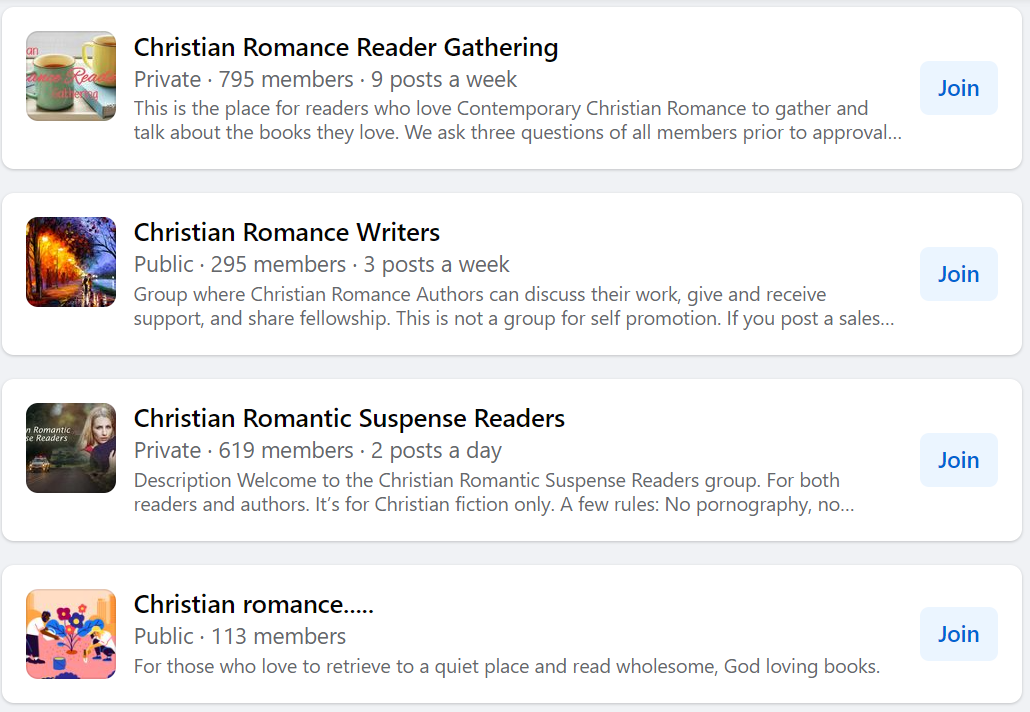
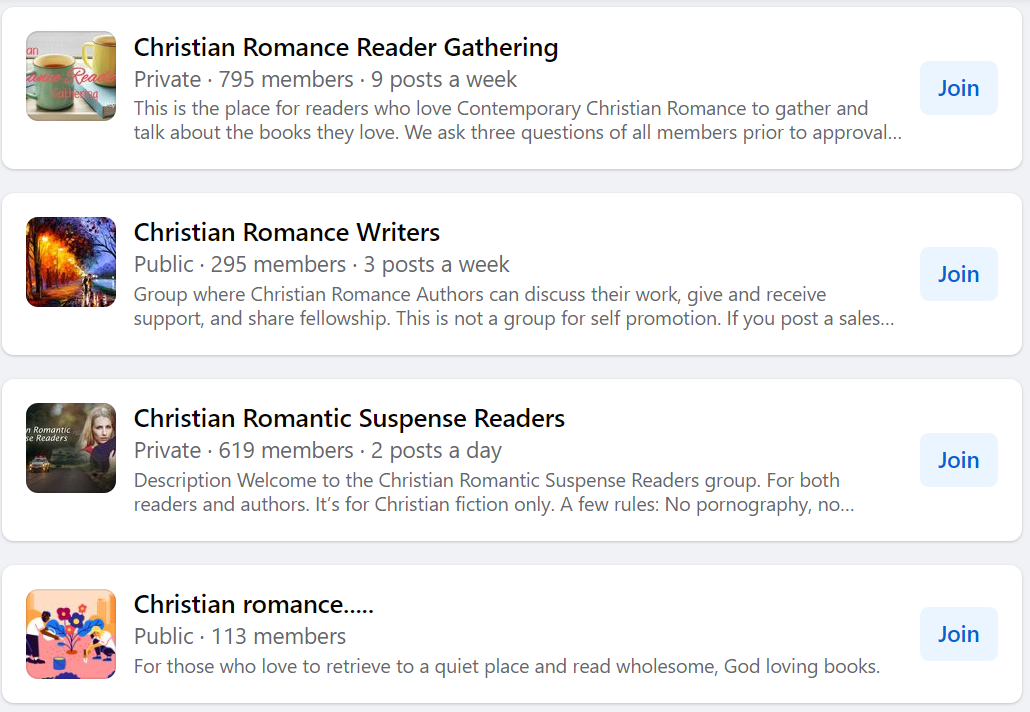
Title the group with search in mind. Facebook is a search engine (not a good one, but it is one). People can search for topics in the search bar, even narrowing their search down to just groups. On top of that, Facebook will recommend groups to people based on their interests. For example, when I searched “Christian romance” in the groups category, I got the following results. With Facebook’s search function, you don’t see many details about the content—so the group name carries a lot of weight. Too often, people opt for a cutesy, fun name, maybe with their brand name in it, but that doesn’t help people answer the question, “What can I expect in this group?” Either make the “fun” name the subtitle or ensure the subtitle is clear and to the point, with relevant keywords. Random people find my group “Christian Novelists & Fiction Writers” through search because it is filled with keywords and it’s also recommended to people interested in Christian writing. Title well.
Collect emails. My next best tip is collecting emails when people sign up for the group. Groups are the number one way I’ve built my email list for this newsletter and my Theophany Media newsletter. Email newsletters are the best way to communicate because constantly changing social media algorithms don’t decide if people see the content. Facebook could shut down my group but I’d still have a way to contact people. If your group is set to private, you can ask custom questions before people enter. Ask for an email (make it clear that it’s optional) and explain what you will do with it (it’s probably best to give some kind of freebie, or explain the value of your email newsletter). I’ve found that about 75% of people give me their email when they join my Facebook groups. But you can also ask for that email after they join the group and you’ve built trust.
EXTRA TIP: When it comes to collecting emails, you can do it manually for free. For my group Creatives Christians Working Together I put their name and email in a landing page which starts an automated series of emails. For this newsletter, I just type the email into a box that Substack provides for me to put emails, which triggers one welcome email. Both processes can be laborious—but there are paid options like Group Funnel that will copy the email addresses and send autoresponders for you!
Have a mission. When starting a group, it’s smart to approach it with a business-like mindset. Begin by defining a clear mission for the group. Crafting a mission statement that describes your goals can be helpful, followed by the establishment of straightforward rules that align with the group’s purpose. One important rule I implement is ensuring that posted content remains relevant to the subject matter. Enforcing such a rule can sometimes lead to confusion among members, particularly when they are asked to adhere to it. On occasion, individuals may express frustration when I don’t permit their unrelated content that lacks relevance to the group's core focus or is overly spammy. Ultimately, maintaining a sense of purpose within the group and consistently upholding these principles is crucial for a functioning group. Allowing a multitude of unrelated content can blur the group’s mission and deter engagement.
Post consistently. Post just enough to constantly get attention to your group but not too much that you annoy people. If you can schedule them, even better. For a while in one group, I had a themed #TipTuesday where I posted a prompt for people to offer a tip every Tuesday at 9am CST. People could expect that post. I’ve even had people reach out to me when I haven’t posted on a certain day asking what was up! Even if you don’t have theme days, consistent posting means people know when to hop on and engage with you. For most of my groups, I try to schedule at least two posts a week with slightly different content that can increase engagement. For a brand-new group, I will post at least three times a week.
Ask open-ended questions in your group. Questions get the most engagement. To make the Facebook algorithm work for you, you need to get comments. Likes don’t mean too much to the algorithm, but comments and shares show people are interested. Make the algorithm work for you by asking really interesting questions that people can’t help but answer. But even more than that, questions create conversations that lead to a healthy group environment, which you can jump into and demonstrate expertise and care. Jesse Synan, the admin of the group Social Media for Christian Writers, adds this wisdom: “Ask solid questions. But easy questions. Get the conversations flowing. That way you’re being social and learning what your community wants to know about next. Then create it! My goal is to always solve a problem so it’s never promotion.”
Give value. While groups are meant to be social, and I love crafting open-ended questions to increase discussion, it’s also important to showcase your own wisdom on the topic. Especially if you are a non-fiction author, people need to see you as more than a “group owner.” You aren’t just a facilitator of the topic; you know your topic. My favorite way to avoid shameful self-promotion while still providing value to my group is to talk about my own experiments with some aspect of the group—something I can offer suggestions on but at the same time takes a posture of humility because it’s still something I’m trying out. For instance, I told one of my groups that I was sending out press releases to newspapers and magazines, which I had never done before, but I also included advice based on my understanding of marketing. I knew I needed to frame the press releases as something that would help THEM more than help me.
Go live. Live video streamed right into your group can be a great way to create a personal connection with people and increase engagement. Oftentimes, Facebook will alert group members that you are going live in the group so that handy notification may get more eyeballs on the video. Live video is also great because believe it or not people, especially younger audiences, are craving authenticity. They like seeing the real person behind the scenes, maybe without make-up or in a slightly messy room or when your kid comes barging to the door. Live videos make you seem like a real person and build “know, like, and trust” so people are more likely to buy from you in the future. You can also interview people on the live video to bring their knowledge and audience to the group.
Moderate the content. I’ve been in some groups that are off-the-rails crazy. Groups break down and stop becoming valuable when anything goes. Similar to point 3 about having a mission, you need to know what content is going to be beneficial to the group and then prevent anything that is going to be a distraction. As a group admin, it’s your job to moderate (or you can get other people on board as well). Your brand is directly tied to how well-organized and chaos-free the group appears. A great trick for moderation is to set all posts for admin approval. That way nothing “bad” gets past you. You can choose to decline posts with feedback and mark which rules were broken as a way to instruct people on how your group works in the future.
Minimize promoting yourself. As an admin, I have the right to break my own rules—I can promote myself! However, I don’t want to abuse that privilege. So I try to minimize self-promotion as much as I can, saving it mostly for super important announcements. However, to get the most bang for my buck, I’ll make that post an “announcement” so it stays at the top of the group and lives beyond the normal life cycle of a post. When I self-promote in my own group, I am always clear about what value it brings to the audience. I’m not going to promote random offerings to my group.
Channel people to your other platforms. Facebook groups are dandy but they are still playing in someone else’s sandbox that you don’t own. Where appropriate, let people know where else to find you, your work, and the conversations you love to have. Get people on your email list (as discussed above) and have them follow you on other social media platforms. Post relevant blog posts so they land on your website as well. The more touchpoints you have with a person, the more likely they are to be a fan that becomes a buyer.

The 3 Pillars of Building an Audience as a Writer

Marketers use the language of “funnel” to represent how to get people from unaware of your existence to becoming a paying customer. The top of the funnel is wide, allowing many people to enter. The bottom is narrower and more focused. When you cast your net wide, statistically only a small number of people will follow you. But that's okay. You don't wan…
Facebook groups can be really wonderful ways to find new readers, engage with existing ones, and establish yourself as an authority. I encourage you to think about starting one!
What other tips do you have for managing a Facebook group to build an audience around your writing?
This post is sponsored by Mini-Marketing Messages Workshop.
Unlock the secrets to crafting engaging social media content for your book, without being pushy, salesy, or overwhelmed. For only $37, gain instant access to workshop videos, Q&A sessions, social media templates, a Canva graphic kit, and a Bridge Building System handout, valued at $633. Say goodbye to confusion and hello to a simple, effective social media strategy that empowers you to impact lives with your message.